Multiplayer AI Is Thinking Too Small
Multiplayer AI is the new, hot idea in the industry right now, but the conversation is far too narrow. Nearly every example is a team of developers sharing an agent, which works because software spent decades building tools for working together in tightly scripted processes. The other 80% of the business economy, where AI still hasn’t really landed, needs something bigger: Collaborative Workspaces.
Collaborative Workspaces where teams…
- Take on the common, recurring work leveraging AI, reaching conclusions everyone understands,
- Handing those conclusions to agentic workflows to carry into the systems where downstream work gets done.
- Do this without locking the company into one vendor while working with the enterprise tools it already runs,
- And respecting the company’s own governance, compliance, and security rules.
Today’s multiplayer hype is a developer story
Multiplayer AI is the right idea. Moving AI from something each of us does alone to something teams do together is the next big step. Y Combinator’s Fall 2026 Request for Startups put it well: “AI hasn’t had its multiplayer moment yet.”
But look at the examples the industry holds up:
- Anthropic says its shared Claude Tag agent now writes 65% of its product team’s code.
- OpenClaw’s maintainers built shared agent sessions to rebuild their software together.
- Slack and Microsoft each shipped coding tools in their multiplayer launches.
- Y Combinator’s own list of use cases starts with engineers coding together in real time.
That makes sense. AI is math, and software is math. Developers were always going to get there first. They had a head start with standard practices like version control, automated tests, shared repositories, code merging and access controls. Multiplayer AI for code sits on top of decades of collaboration infrastructure.
The rest of the enterprise has tried various approaches. SharePoint, Slack, and Knowledge Management Systems and wikis all exist to help people work together. But none of them come close to what engineering teams take for granted: one source of truth, a record of every change, and a test that shows whether the work is right. Outside of the technology sector, in banking, healthcare, services, and government, dropping a shared agent into a chat channel is not a multiplayer moment. It is one more place for work to scatter.
Same data, two different stories
Here is what single-player AI looks like in a real business.
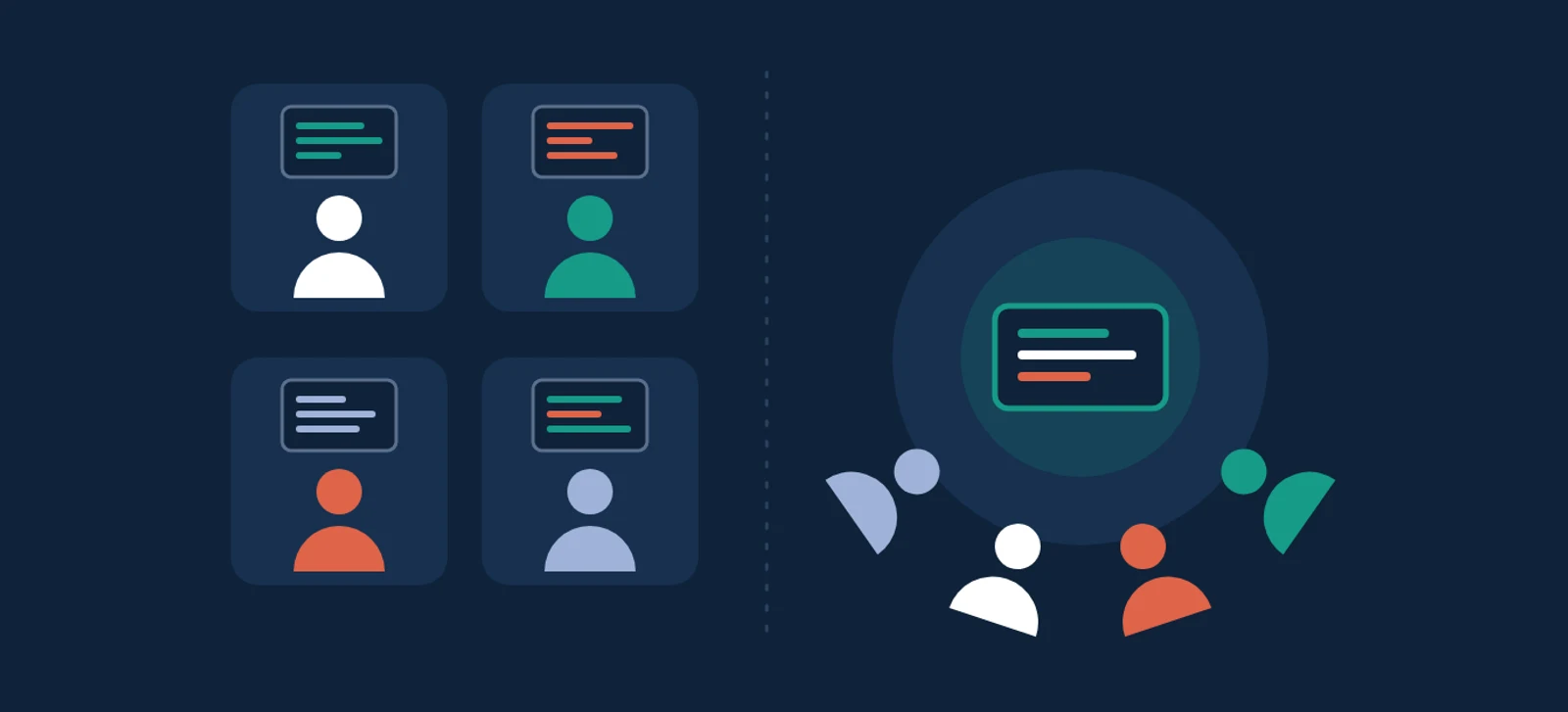
A key customer’s quarterly business review is next week. The sales account manager opens an AI chat and asks how the customer is feeling about the relationship. Down the hall, the customer success manager does the same thing. They are pulling from the same data. But they use different models and ask the question in different words, and large language models provide answers based on probabilistic calculations. Ask the same question two different ways and you can get two different answers; our example sales account manager and customer success manager are living that reality.
Then they walk into a meeting with the chief revenue officer and paint two different pictures of the same account. The meeting turns into a debate about whose AI is right, instead of a decision about what to do.
AI made each of them faster. It made the team slower.
What a collaborative AI workspace changes
Quarterly business review prep comes around every quarter for every key account, which makes it exactly the kind of work a workspace is built for. Now run the same week in a collaborative workspace, where AI is a highly capable member of the team instead of a private assistant.
They do the work together. Both people work from the same information with the same AI, in the same place. Everyone can talk to the AI and to each other in one shared conversation, so each person sees the questions, the answers, and the thinking as the work unfolds. The AI is treated like a super fast, super smart member of the team. And in minutes, it does what AI is great at: comparing this account with similar ones, reviewing the customer’s recent public statements and blog posts, mining enterprise systems (Salesforce, Zendesk, Slack, email, SharePoint, etc.) for updates, and surfacing changes in activity or tone.
The team reaches one conclusion. Not necessarily a formal decision, but a shared view of where the account stands and how to position the review. Everyone can see how the team got there: which data, which questions, and which insights changed their minds. That becomes the team’s shared reference point and shared learning for the next account.
Then the work moves. The conclusion kicks off agentic workflows. One builds the quarterly business review deck from the standard, branded template. Another updates the customer record in HubSpot. Another updates the forecast in the finance system and refreshes the top-customer dashboard on the company wiki. The thinking happened together, so the follow-through can be automated with confidence.
That is the real multiplayer moment for knowledge work: think together, agree together, then act. A shared chat channel gets you only part of the first step.
What it takes in a real enterprise
That workspace model works for enterprises if it clears three bars:
It has to be neutral. The enterprise needs to control its own destiny. Slack, Microsoft and Glean have each shipped their own multiplayer AI in the last six weeks, and Forrester predicts most enterprises will adopt it by accident because it simply shows up in tools they already own. Each version is multiplayer inside its own walls, with its own memory and its own rules. That trades a thousand private chats for five or six walled gardens. The workspace, the process, and what the team learns should belong to the company and work across any model or vendor.
It has to work with the tools you already run. The quarterly business review story touches a CRM, a finance system, a company wiki, a slide deck, and public data. Real businesses run on a mix of first-party platforms and systems they built themselves. AI has to come to those tools and make them smarter, not ask everyone to move into a new one.
It has to answer to your rules. Every agent, skill, and workflow should run as the person directing it, limited to that person’s identity and access. Working with the same agent in the same workspace as your CFO must never give you CFO level access. Sensitive data should be stopped before it reaches a 3rd party model, and every action should respect the governance, compliance, and security frameworks the organization already has. Without that, the most valuable work (the forecast, the deal, the board deck) never becomes safe to share.
AI’s multiplayer moment shouldn’t belong to developers alone
This is our view, and it is why we built Holokai Workspaces. Multiplayer AI is coming, and developers are showing what is possible. But for the bankers, clinicians, engineers, analysts, and public servants who make up a lot of the workforce, the moment won’t arrive through a smarter chat channel.
It arrives when a team can engage with AI as a capable colleague, work through the tasks the business runs every day, week, and quarter, agree on what the results mean, and, on their own terms and under their own rules, set the next steps in motion. That is the collaborative workspace. That is where AI finally lands for knowledge workers and the broader business economy.
Inside Holokai Workspaces
Holokai Workspaces bring that model to life. Each workspace is built around a common or repeating business task that benefits from AI, such as quarterly business review prep, candidate reviews, or the monthly forecast, and gives the team:
- Real collaboration. Multiple team members work with AI and with each other in one shared conversation, with full visibility into how the work progresses.
- Connections to the tools you run. Workspaces connect to third-party platforms and to the applications you built yourself.
- Active policy and governance enforcement. Every agent, skill, and workflow runs under the identity and access of the person directing it—with your policies enforced as the work happens, not reviewed after the fact.
- Persistent views and dashboards. Views built in the workspace stay live and keep updating.
- Persistent data sets. Data created in the workspace is retained and kept current, not buried in a chat history.
- Workspace memory. The workspace learns how your team works, so the 50th resume you review reflects everything it has learned about how you and your team evaluate candidates.
- Automations. Agentic workflows, both standard ones and ones built for the workspace, automate the work inside the workspace and the downstream work that follows.